The Art of Kantha Embroidery
The Craft
What is Kantha?
Kantha is one of the oldest forms of embroidery in the Indian subcontinent — a craft born not from luxury, but from necessity. The word kantha comes from the Sanskrit root kontha, meaning “rags” or “old cloth.” At its origin, it was the art of mending — of taking worn-out cloth and, through patient stitching, giving it new life.
At its most elemental, Kantha is the running stitch — a needle moving in and out of layered cloth in a rhythm that is meditative, precise, and deeply human. The simplicity of the stitch belies its power: in skilled hands, it can create shimmering textures, flowing pictorial narratives, and textiles that feel alive to the touch.
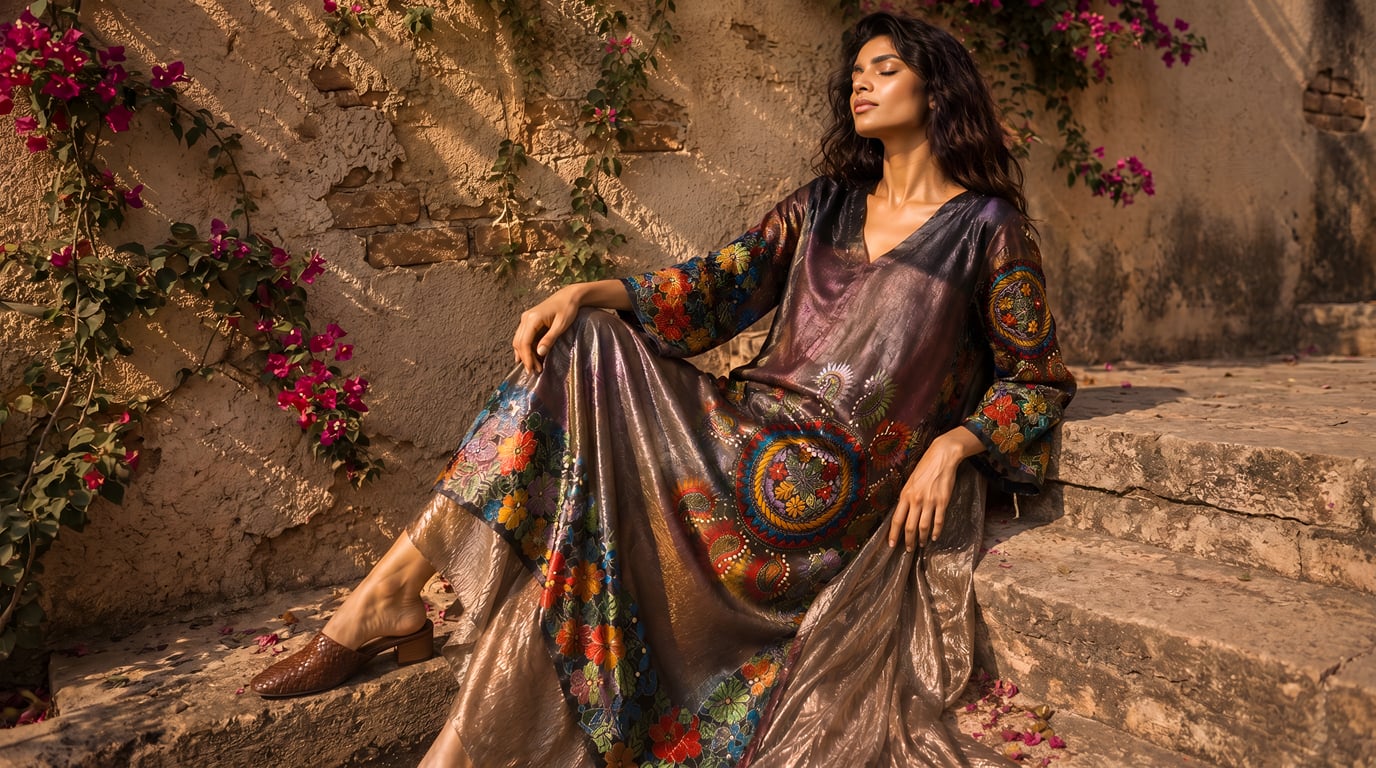
Today, Kantha appears on silk sarees, cotton dupattas, quilts, jackets, and stoles. But its spirit remains unchanged: it is cloth that has been listened to, worked with, and transformed through patience and intention. Each piece is unique. Each stitch is placed by a human hand. No two pieces are ever truly identical.
At Maatir Maanush, we work exclusively with artisans who have inherited this tradition — women in rural Bengal for whom Kantha is not a hobby or a livelihood choice, but a language.
History & Origins
Bengal Roots
Ancient Origins
Kantha's origins in Bengal stretch back at least to the 5th century CE, with references found in early Buddhist texts. Women in rural Bengal quilted together worn saris and dhotis — creating layered cloth that was warmer, stronger, and more durable than any single piece of fabric. The resulting quilts were called kantha, and they served a deeply practical purpose: keeping families warm through the Bengal winter.
15th–18th Century: Devotion and Ritual
By the medieval period, Kantha had taken on sacred dimensions. Women stitched kanthas as votive offerings to temples, as swaddling cloths for newborns, and as ceremonial covers for sacred texts. The motifs evolved: the lotus, the tree of life, the fish, the sun and moon — each loaded with meaning drawn from Hindu, Buddhist, and local folk traditions.
19th Century: Documentation & Displacement
The arrival of British colonial rule brought profound disruption to Bengal's textile traditions. As machine-made cloth became available and cheap, the economic logic of kantha diminished. Yet the women continued to stitch. By the late 19th century, collectors and scholars began to document the craft. Rabindranath Tagore championed Kantha as a living art form deserving of recognition alongside the great textile traditions of India.
Post-Independence Revival
After 1947, a series of revival efforts — most significantly through cooperatives established by women's organisations in West Bengal and Bangladesh — brought Kantha back. Today, Kantha is a GI (Geographical Indication) tagged craft of West Bengal, and its practitioners are recognised as master artisans.
Culture & Meaning
Why Kantha Matters
Women's Authorship
Kantha is one of the few artistic traditions in South Asia where women were the primary creators, curators, and transmitters. The canon of Kantha motifs was passed mother to daughter across centuries — an oral tradition expressed in thread.
Zero Waste Ethos
The original Kantha was made from reclaimed cloth — worn sarees layered and stitched into new objects. This is not a modern sustainability claim. It is an ancient practice that understood waste as a failure of imagination.
Living Memory
Kantha motifs encode local knowledge — the flora and fauna of Bengal, the rituals of the agricultural calendar, the cosmology of people. To own a Kantha piece is to hold a fragment of that archive.
The Process
How a Kantha Piece is Made
From raw cloth to finished textile — a journey measured in weeks, not hours.
Cloth Preparation
Layers of old or new cotton or silk cloth are stacked and basted together. Traditionally, worn saris and dhotis were recycled — giving the fabric a second life through the hands of the artisan.
Motif Design
Designs are drawn freehand — no stencils, no transfers. The artisan carries the motif in memory, passed down through generations. Each motif carries meaning: the lotus for purity, the fish for fertility, the tree of life for continuity.
The Running Stitch
The defining Kantha stitch is a simple running stitch — needle in, needle out — worked in cotton thread across the cloth. What appears simple is deceptively skilled: the tension, spacing, and rhythm determine the texture and drape of the finished piece.
Filling & Density
Different Kantha styles vary in stitch density. Nakshi Kantha is fully filled with fine stitching; Sujani Kantha uses sparse stitching on a pictorial ground. Each style requires weeks to months of sustained work.
Finishing
The finished piece is washed, pressed, and inspected. A hand-stitched Kantha develops a subtle ripple and warmth — a characteristic wrinkle that is not a defect but a signature. It cannot be replicated by machine.
Explore the Collection
Experience it for yourself.
Every piece in our collection is a direct continuation of this tradition. Slow made, artisan first, built to last.